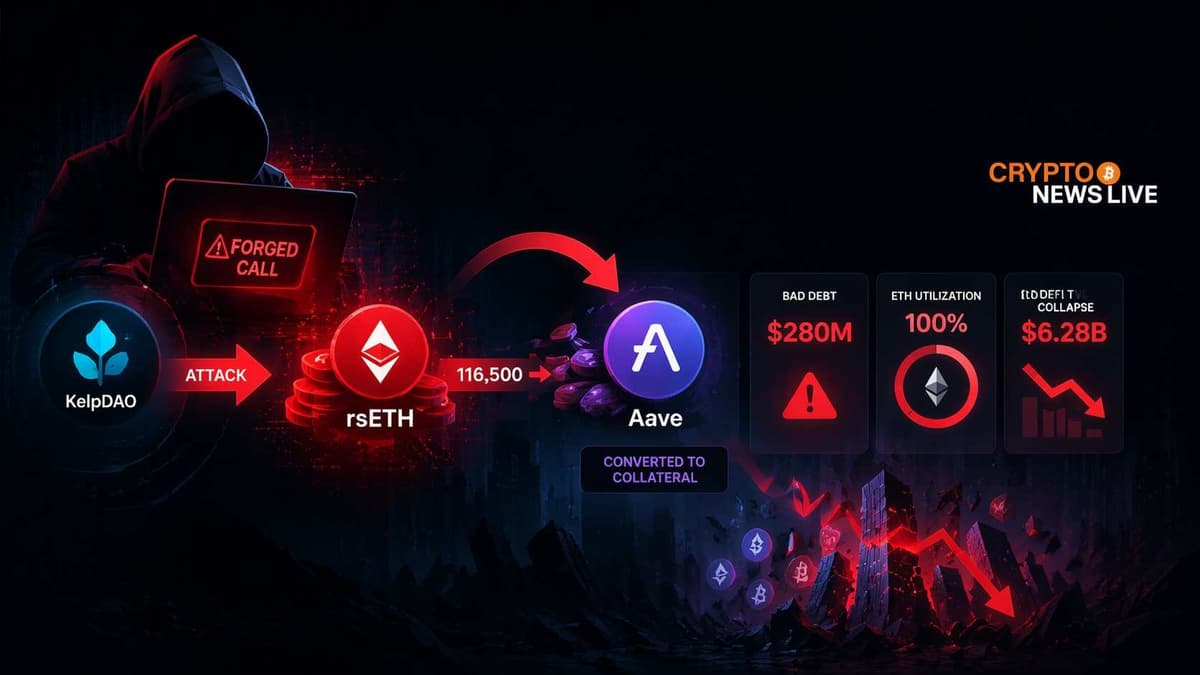
At 17:35 UTC on April 18, 2026, an attacker called the lzReceive function on LayerZero’s EndpointV2 contract. That single call forged a cross-chain message, tricked KelpDAO’s bridge into treating it as legitimate, and released 116,500 rsETH to a wallet under the attacker’s control. No real ETH backed any of it.
According to the DefiPrime forensic report, those 116,500 tokens were worth roughly $292 million at execution. They made up 18% of rsETH’s entire circulating supply of approximately 630,000 tokens. The exploit broke what blockchain engineers call omnichain supply conservation. rsETH was minted on Ethereum mainnet without any corresponding destruction on the source chain. The bridge simply released funds it was never supposed to release.
Six attacker wallets had been pre-funded through the Tornado Cash 1 ETH pool roughly ten hours before the drain. On-chain investigator ZachXBT flagged the breach on Telegram within hours, identifying those wallets and connecting the addresses to the theft. A deliberate, precisely prepared operation. Not opportunistic.
How the Bridge Broke
KelpDAO runs a liquid restaking protocol on Ethereum. Users deposit ETH or liquid staking tokens like stETH and cbETH. They receive rsETH in return, a token that accumulates rewards through EigenLayer’s restaking layer on top of standard Ethereum staking returns. The protocol held roughly $1.07 billion in total value locked and sat as the second-largest player in the EigenLayer ecosystem.
rsETH was deployed across more than 20 blockchain networks, including Arbitrum, Base, Linea, Blast, Mantle, and Scroll, via LayerZero’s OFT standard. The bridge that was drained held the reserve backing all wrapped versions of rsETH on those networks. Drain the bridge, and every rsETH circulating on every L2 loses its backing in a single transaction.
The exploit worked because the lzReceive function accepted a forged cross-chain message as valid. The attacker’s call convinced KelpDAO’s OFTAdapter to release the tokens without any legitimate transfer request originating from another chain. The bridge did not verify the message’s true source correctly. 116,500 rsETH moved to the attacker’s address. KelpDAO’s emergency multi-sig executed pauseAll at 18:21 UTC, 46 minutes after the drain, freezing the LRT Deposit Pool, the Withdrawal contract, the LRT Oracle, and rsETH tokens themselves.
Two follow-up attacks came at 18:26 UTC and 18:28 UTC, each targeting another 40,000 rsETH representing close to $100 million more. Both reverted because the contracts were already paused. Without that pause, the total loss would have approached $391 million.
KelpDAO confirmed on X it had identified suspicious cross-chain activity and paused rsETH contracts across mainnet and several L2s. The protocol said it was working with LayerZero, Unichain, auditors, and top security experts on root cause analysis.
The Second Move: Aave as the Exit
Stealing $292 million in rsETH was only the first half of the operation. The attacker needed to convert those tokens into real value. The mechanism they used turned a bridge exploit into a lending protocol crisis.
The stolen rsETH was deposited into Aave V3 as collateral. Against it, the attacker borrowed approximately $236 million in WETH. Real ETH, borrowed against tokens with no underlying backing, because KelpDAO’s reserves were already gone. That loan will never be repaid. Aave was left holding the bad debt.
Aave confirmed on X that rsETH markets on both Aave V3 and V4 had been frozen. The statement was direct: Aave’s own contracts were not exploited. The problem originated with rsETH itself. The protocol confirmed it was reviewing borrow activity connected to the exploit and would look at options to offset any deficit if bad debt materialized.
Aave founder Stani Kulechov followed with his own post. As Kulechov stated on X, rsETH was frozen on Aave V3 and V4 with borrowing power removed as a precautionary measure tied to the KelpDAO bridge exploit, which he confirmed had occurred entirely outside of Aave’s contracts.
ETH Utilization Reached 100 Percent. Lenders Could Not Exit.
The attacker’s borrow activity did not just create bad debt. It consumed Aave’s ETH liquidity. As the borrow volume stacked up and whales began rushing to pull their ETH out, the utilization rate on Aave’s ETH pool climbed to 100%.
lookonchain reported on X that the attacker deposited rsETH into Aave to borrow ETH, creating bad debt on the protocol. Whales responded by withdrawing ETH en masse. ETH utilization hit 100%. Any WETH lender still inside Aave at that point could not withdraw.
The situation was not theoretical. deacix described it directly on X:
“I’m a WETH provider on @aave watching my position go negative after the @KelpDAOxyz rsETH exploit. Can’t withdraw, 100% utilization. Every failure here is a feature of shared-pool variable-rate lending.”
Solidity developer and auditor 0xQuit separately flagged on X that the WETH pool was effectively impaired, warning depositors that partial withdrawals might only become possible once Aave’s Umbrella backstop module settled the deficit. Retail lenders who had nothing to do with rsETH were locked inside a pool drained by someone else’s exploit.
The Full Scale of the Damage
coinbureau laid out the totals on X in a post issued at 08:05 UTC on April 19: AAVE had fallen 19% on the day. The attacker drained 116,500 rsETH worth $292 million, deposited it as collateral on Aave V3, borrowed roughly $236 million in WETH, and left Aave carrying approximately $280 million in bad debt. ETH outflows from the protocol hit $5.4 billion.
The TVL numbers confirmed it. A second post from lookonchain on X reported that the exploiter borrowed over 82,600 ETH valued at $195 million from Aave using rsETH as collateral. Aave’s TVL dropped from $26.396 billion to $20.114 billion. A $6.28 billion decline within hours of a single exploit.
KelpDAO’s own TVL, which had sat near $1.07 billion before the attack, faced immediate pressure as rsETH’s peg held only as long as confidence in the protocol’s ability to recover.
Justin Sun Goes Public With the Attacker
While DeFi protocols scrambled to contain the damage, TRON founder Justin Sun took an unusual step. As justinsuntron posted on X at 08:26 UTC on April 19:
“OK, Kelpdao hacker, how much you want? Let’s just talk. With KelpDAO’s help, of course. It’s simply not worth it to sacrifice both Aave and KelpDAO and let them go down over this hack. You can’t spend $300 million anyway.”
Sun’s public negotiation attempt drew attention across the space. No response from the attacker has been made public. Whether the funds move through Tornado Cash before any recovery window closes remains an open question.
LayerZero responded on X, confirming it had been in active remediation with the KelpDAO team since the incident began. It stated all other applications using LayerZero infrastructure remained safe and committed to publishing a full post-mortem alongside KelpDAO once the root cause analysis was complete.
DeFi’s Chain Reaction: Who Froze, Who Confirmed Zero Exposure
The hours after the exploit triggered one of the widest coordinated emergency responses across DeFi protocols in 2026.
Lido Finance confirmed on X that its earnETH product held exposure to rsETH and paused further deposits as a precaution. A separate Lido post clarified explicitly: stETH and wstETH were entirely unaffected, with the core Lido staking protocol having no involvement in the incident whatsoever.
Fluid announced on X it had paused markets with potential exposure to the ongoing KelpDAO incident. It reported no material rsETH exposure on L2s, confirmed no new borrowings against rsETH occurred after the exploit window, and stated user funds remained secure.
Ethena confirmed on X it held no exposure to the rsETH exploit on the Aave V3 mainnet instance. The protocol paused its LayerZero OFT bridge as a precautionary measure while investigation continued, noting it remained more than 101% overcollateralized throughout.
Euler Finance confirmed on X it was aware of the incident and paused Ethereum mainnet and Linea markets as a precaution to prevent affected assets from being used as collateral. Both were subsequently unpaused after Euler confirmed zero exposure. In a follow-up, Euler noted on X it was also temporarily suspending EUL LayerZero OFT bridges while the root cause was still being investigated.
f(x) Protocol stated on X it had no exposure to the rsETH incident on Aave V3 and paused its LayerZero OFT bridge as a precaution. Nest confirmed on X it had no exposure to the rsETH exploit, had paused all LayerZero OFT activity, and described all vaults as secure. Reservoir confirmed on X that OFT bridging had been temporarily paused, that rUSD remained fully collateralized, and that it held no rsETH exposure.
Compound’s security partners posted a response on the Compound governance forum acknowledging affected markets and detailing ongoing monitoring and paused handling procedures.
SparkLend froze its rsETH markets and reported minimal direct loss, crediting its conservative risk profile for keeping exposure low.
DeFi’s Worst Year on Record Gets Worse
The broader context for this exploit is not comfortable reading. alicharts noted on X, citing Chainalysis data, that the crypto industry was already coming off its most devastating year on record. Over $3.4 billion was stolen across DeFi in 2025 alone.
KelpDAO’s $292 million loss is now the single largest DeFi exploit of 2026, overtaking the Drift Protocol incident from April 1, which saw roughly $285 million drained in an attack later tied to North Korean-affiliated actors. The Kelp loss exceeds Drift by a margin of roughly $7 million. Combined with CoW Swap, Zerion, Rhea Finance, Silo Finance, and at least a dozen other smaller protocols exploited in the weeks between, the picture for DeFi security in 2026 is deteriorating.
The attack’s architecture was deliberate. Wallets pre-funded through Tornado Cash. A forged message targeting a specific function in a specific contract. Follow-up attempts executed minutes after the initial drain. A calculated move into Aave to extract real value from stolen tokens before the bridge could be frozen. Blockchain security firm Cyvers confirmed approximately $250 million of the stolen rsETH had already been swapped for ETH by the time protocols had finished issuing their emergency statements.
KelpDAO has not publicly disclosed how the lzReceive function was able to accept a forged message as valid. The full post-mortem from LayerZero and KelpDAO has not been published. rsETH’s ability to hold its peg through the weekend depends on how much of the cross-chain float attempts to redeem back into ETH on Ethereum mainnet, and how much of the stolen funds can realistically be recovered before the on-chain trail disappears entirely.